The problem with math is the wording of problems.
The longer I teach, the more I realize that I don't know what I'm doing. No - wait. That's not flattering, is it?
I do know what I'm doing when it comes to: planning and plotting, marking and giving feedback, building healthy, positive relationships with every student.
But, I don't know what I'm doing when it comes to: letting them find the way.
I think that the biggest problem we, as teachers, have created for ourselves is that we don't let them find their way. In fact, we have created so many parameters that we have all but cornered ourselves into teaching.
Yes, there is a curriculum.
No, it doesn't need to be followed from expectation #1 to expectation #1million or whatever the last one is.
Parameters is something that clicked for me during a Hub. I realized the problem with our questions was that we:
- assume that they know the parameters that we know, because we looked at the curriculum and "designed" the question in a brilliant way
- get upset when they build their own parameters and don't go the direction we were expecting
- get upset when we want them to build parameters and they don't because they don't know how or think that they're allowed, because we got upset when they did it before
Phew. Take a moment to let that all soak in.
So what do we do?
I've started trying to design questions that have missing information. I'm hoping that by allowing for - and discussing with the students - the parameters that are missing, that are present, and that are IMPORTANT, some of this silliness can be avoided. Afterall, if I pose a question and the students solve it according to their parameters - they do the leg work, can prove their thinking, and are finished shortly thereafter ... what's the problem? It didn't hit on the right curriculum expectations? Not to be crass, but hey, shut up and be happy. Make a note in your anecdotal records, where ever you keep them (mine are in my phone under the Memo app), identify what expectations they DID meet, and move on.
Here's an example of a problem I gave with little parameters. I wanted to see where they went:
Create an equation to show how many days of school the students attended, if there are 194 days of school.
Note: We've been working on equations, symbols and missing values, constants and variables. This was all highlighted before we got to the question.
I wanted to see where they would go. I knew some would do this:
- how many days did ONE student go to school?
- how many days did OUR CLASS go to school by the end of the year?
- Where is the attendance?
None found the answer for the students in the entire school. Most focused on the FINAL ANSWER and NOT the equation part, which was really the only concrete parameter I gave. But that's okay, I took the info and incorporated it into the next day's problem, and identified it during our wrap-up.
Most students looked at attendance, made tables and charts, and found out how many days of school had been attended to date. THAT is good, since we obviously don't know about future snow days or sick days.
One group identified this equation: 21 (students) x 194 - DM (days missed) Perfection. Sorta.
This question is WIDE OPEN. On purpose.
Here is a LESS wide open question:
Build an equation to show how much Mr. Patrick makes, if he earns $10 an hour. (Note: You can change it to challenge yourself.) How much will he make in:
- a day's work?
- a week's work?
- a school year's work?
This was surprisingly difficult for the kids. Not the finding the answer part, but the finding the equation part (which in this case, is the answer, actually). Of course, I know I can say "If I make $10 an hour and work 7 hours a day, I will make $70/day. So, take the days worked and multiply that by the amount I make: D (days) x $70 = answer. But, different people set up different parameters.
They wanted to know:
- how long do you work?
- how long is the school day?
- does it include breaks?
- do you get paid if you do more?
- do you get paid if you stay late? come in early?
- do we count weekends?
- are holidays part of the 194 days at school? should I take them out? what about snow days?
And so on. It was impressive. They built rules for themselves, and found answers that suited their own set of rules. I still got what I needed from them, even though many didn't quite make it to that FINAL ANSWER. It's okay. It was a positive experience, and I got to see (from the two days featuring these questions) that they have solid skills to find answers, even if it is not as quick and efficient as using an equation with constants and variables.
End of the world? No way.
Let them eat cake! I say. Oh, and let them build their own parameters, which are suitable and informed and make sense and are important to the problem, and then we'll all be happy ... and we can eat cake. Who wants to split it into fractions for me?
Saturday, February 23, 2013

Tuesday, February 12, 2013
Phrases That Worry Me
When teaching in general, there are certain words, phrases or combinations of them that worry me. I can apply these directly to teaching math, as I myself have used them in the past, and I hear them from others, either when passing the doorway in the hall, or in conversation about what the students are doing.
These are some of my favourites; the ones that worry and bother me the most (especially when it slips out of my own mouth):
- "This isn't hard." Maybe it is. It isn't hard for us, because we're adults. But maybe the concept, the numbers, or something else is hard. Maybe there are outside forces that we don't know about making it difficult for the child. Maybe it shouldn't be hard, in our perspective, but if a child struggles over something, simple or not, then isn't it my job to make it not hard? Isn't the root word of "teacher": TEACH?
- "I've already taught them this, so ..." So what? Maybe you taught it, but did they learn it? Did they really, deeply learn it? Did they experience it beyond a lecture, a trite activity, or something that made sense in my/your mind? You may have already presented it, but it doesn't mean they know it. And that is the rest of the job. A teacher might teach something, but until a teacher has observed, made adjustments, and ensured a solid understanding of the materials, the job isn't done. Even if the lesson was already taught.
- "I haven't taught this yet, so ..." So what? Maybe they know it. Maybe it's simple for some of them. Maybe our words convolute things and confuse them, and then we start saying, "But I already taught them this," even though they already knew it. Meaningful, open diagnostic assessment not only saves time, but can act as a teacher in itself, if not for the students, then for us as teachers; in fact, something that a child creates may end up teaching the other students in some way, at some point.
- "That child is a 3." Or a 2, or a 1, or a 4. In other words, a B, or a C, D or A. You know what? You're probably wrong. Maybe your assignments only allow the child to achieve that. Maybe the environment, the classroom climate, only allows it. Maybe that child normally scores a C, but actually gets it. Our jobs as teachers are to teach kids, not to keep their level steady with what every teacher before us has pegged the child as.
There are millions more, but I'll leave it at that. I know I've said these things in the past, but the more I learn about teaching, the more I learn that I don't know as much as I once thought I did, and the more I learn that teaching is a careful art - a dance that requires two-way communication, flexibility and empathy.
These are some of my favourites; the ones that worry and bother me the most (especially when it slips out of my own mouth):
- "This isn't hard." Maybe it is. It isn't hard for us, because we're adults. But maybe the concept, the numbers, or something else is hard. Maybe there are outside forces that we don't know about making it difficult for the child. Maybe it shouldn't be hard, in our perspective, but if a child struggles over something, simple or not, then isn't it my job to make it not hard? Isn't the root word of "teacher": TEACH?
- "I've already taught them this, so ..." So what? Maybe you taught it, but did they learn it? Did they really, deeply learn it? Did they experience it beyond a lecture, a trite activity, or something that made sense in my/your mind? You may have already presented it, but it doesn't mean they know it. And that is the rest of the job. A teacher might teach something, but until a teacher has observed, made adjustments, and ensured a solid understanding of the materials, the job isn't done. Even if the lesson was already taught.
- "I haven't taught this yet, so ..." So what? Maybe they know it. Maybe it's simple for some of them. Maybe our words convolute things and confuse them, and then we start saying, "But I already taught them this," even though they already knew it. Meaningful, open diagnostic assessment not only saves time, but can act as a teacher in itself, if not for the students, then for us as teachers; in fact, something that a child creates may end up teaching the other students in some way, at some point.
- "That child is a 3." Or a 2, or a 1, or a 4. In other words, a B, or a C, D or A. You know what? You're probably wrong. Maybe your assignments only allow the child to achieve that. Maybe the environment, the classroom climate, only allows it. Maybe that child normally scores a C, but actually gets it. Our jobs as teachers are to teach kids, not to keep their level steady with what every teacher before us has pegged the child as.
There are millions more, but I'll leave it at that. I know I've said these things in the past, but the more I learn about teaching, the more I learn that I don't know as much as I once thought I did, and the more I learn that teaching is a careful art - a dance that requires two-way communication, flexibility and empathy.
Thursday, February 7, 2013
What ARE We Teaching?
Today I attended a hub. If you don't know what that is, here's the quick & dirty explanation:
Small groups of teachers, from various schools, meet up monthly for a day to inquire about learning.
Being inquiry based, we start with some sort of a plan, and led by fearless leaders, we go into a classroom and observe the students. Then, we come back to the table, discuss what we saw, and usually make some minor changes to the lesson, and try it all again. Today we really got into looking at "what comes next?" I'm happy about that. I needed to know what came next. I feel comfortable with the classroom climate, student voice and problem based learning in my classroom. What I need as an adult learner now is just that - now that I have this data, what do I do next? And am I really seeing what I think I'm seeing?
Today revealed some amazing things. We were in a Gr. 7 classroom, and the whole learning continuum really presented itself today. The students were looking at a problem with fractions, but the question didn't explicitly state that it was about fractions. I wonder if some of them even knew it was? As we let them tackle the problem, we realized that there were some missing pieces.
We reconvened and discussed the triumphs and struggles. We got into smaller groups and presented our own observations, and then categorized them. My group came up with headings like "Classroom Climate," and "Assumptions," and "Misconceptions" and "THE Math - Number Sense." It was fairly obvious that as a whole, the class was missing major fundamental pieces, which were required in order to do THE math.
After much tribulation, we went back in with the prompt:
Design something to help the Gr. 4 students at (my school, not the highschool) learn about fractions.
Well.
It was a dud, I would say. While some groups had some ideas, I think it is fair to say that they couldn't access the information without going to the internet. That's a great strategy, except ... I don't think they were doing much other than regurgitating the information they'd found.
So now I'm left with these wonderings ...
- What ARE we teaching in primary & junior?
- Why AREN'T the fundamental concepts sticking with them?
- Is our teaching and their learning TOO compartmentalized?
- Is this because of text books?
- Is this because many of us have a discomfort with things like fractions, so we spit out the words, they "parrot" it back (to borrow the term from one of the resources we looked at today!), and then we say "Check! Moving on!"?
- Is this because the climate surrounding math has been, as a whole, stuffy? Overwhelming? Anxiety-ridden? Why?
- Is this because they just can't remember?
- Do they have the language to get to the language or strategies that they need to understand it all?
- Are they worried about using the right words and pictures to please the teachers?
- Do we even know what kind of understanding we want to see from them? I'm not sure I did.
I wonder if manipulatives (for those non-teachers reading, I mean the thingies they use to solve problems, like counters and blocks and so on) are the issue, too? Do the kids stop using them in junior, and then not want to use them in intermediate, because it means that they're unable to solve the problem with their heads? If that's it, we've got some major work to do around our classroom cultures. I wonder if manipulatives looked cooler and more "adult" (maybe metal or polished fine wood blocks and counters instead of primary red, yellow and blue), would older kids be more comfortable with them? I wonder if these kids were uncomfortable because the problem wasn't the kind that they are used to, and so they have trouble accessing the strategies that they need to solve it? I don't know - I'm not the teacher and I don't work in the school. I wonder if the kids would be more able to solve the problem if there was something more motivating about it? I don't know - I don't know them and I don't know what motivates a 13 or 14 year old - I've only taught up to 11 years old.
So many wonders. So little time.
Small groups of teachers, from various schools, meet up monthly for a day to inquire about learning.
Being inquiry based, we start with some sort of a plan, and led by fearless leaders, we go into a classroom and observe the students. Then, we come back to the table, discuss what we saw, and usually make some minor changes to the lesson, and try it all again. Today we really got into looking at "what comes next?" I'm happy about that. I needed to know what came next. I feel comfortable with the classroom climate, student voice and problem based learning in my classroom. What I need as an adult learner now is just that - now that I have this data, what do I do next? And am I really seeing what I think I'm seeing?
Today revealed some amazing things. We were in a Gr. 7 classroom, and the whole learning continuum really presented itself today. The students were looking at a problem with fractions, but the question didn't explicitly state that it was about fractions. I wonder if some of them even knew it was? As we let them tackle the problem, we realized that there were some missing pieces.
 |
| This group found out from another that they could divide the two numbers to find the decimal. But, they didn't have enough fundamental understandings to be able to identify what each number meant, or what to do once they'd found every decimal. For this problem, and for their fractional understandings, that's a big gap that we can now fix, because we found out about it. |
We reconvened and discussed the triumphs and struggles. We got into smaller groups and presented our own observations, and then categorized them. My group came up with headings like "Classroom Climate," and "Assumptions," and "Misconceptions" and "THE Math - Number Sense." It was fairly obvious that as a whole, the class was missing major fundamental pieces, which were required in order to do THE math.
 |
| Working together to look at our observations, wonders & student quotes to find some common themes. Quotes like "I'm so confused ... I'm getting mad. I'm gonna spazz out!" were very telling, and informed us that some students are putting up walls ... so how do we target that now for them, and how do we target that for students who are beginning to feel that way now, in primary & junior grades? |
 |
| After our small group sharing and categorizing, we got together to see if we could group what we'd found: were there common themes happening? And then, how could we possibly target them? WHAT COMES NEXT? |
Design something to help the Gr. 4 students at (my school, not the highschool) learn about fractions.
Well.
It was a dud, I would say. While some groups had some ideas, I think it is fair to say that they couldn't access the information without going to the internet. That's a great strategy, except ... I don't think they were doing much other than regurgitating the information they'd found.
So now I'm left with these wonderings ...
- What ARE we teaching in primary & junior?
- Why AREN'T the fundamental concepts sticking with them?
- Is our teaching and their learning TOO compartmentalized?
- Is this because of text books?
- Is this because many of us have a discomfort with things like fractions, so we spit out the words, they "parrot" it back (to borrow the term from one of the resources we looked at today!), and then we say "Check! Moving on!"?
- Is this because the climate surrounding math has been, as a whole, stuffy? Overwhelming? Anxiety-ridden? Why?
- Is this because they just can't remember?
- Do they have the language to get to the language or strategies that they need to understand it all?
- Are they worried about using the right words and pictures to please the teachers?
- Do we even know what kind of understanding we want to see from them? I'm not sure I did.
I wonder if manipulatives (for those non-teachers reading, I mean the thingies they use to solve problems, like counters and blocks and so on) are the issue, too? Do the kids stop using them in junior, and then not want to use them in intermediate, because it means that they're unable to solve the problem with their heads? If that's it, we've got some major work to do around our classroom cultures. I wonder if manipulatives looked cooler and more "adult" (maybe metal or polished fine wood blocks and counters instead of primary red, yellow and blue), would older kids be more comfortable with them? I wonder if these kids were uncomfortable because the problem wasn't the kind that they are used to, and so they have trouble accessing the strategies that they need to solve it? I don't know - I'm not the teacher and I don't work in the school. I wonder if the kids would be more able to solve the problem if there was something more motivating about it? I don't know - I don't know them and I don't know what motivates a 13 or 14 year old - I've only taught up to 11 years old.
So many wonders. So little time.
Saturday, January 19, 2013
Kickin' It Old School But Not Really
There's a common belief out there that when you start doing things "new school" style like I do (my side bar will be in the next paragraph), you need to completely abandon everything that doesn't resemble students milling about, talking, writing on non-traditional surfaces and working on basic skills. It's a misconception! No, you won't find me rhyming off the times tables in sing-song with my Grade Fives during class time. For one, that sing-song style drives me bananas and I'd rather sit in silence all day than take part in it. It's condescending to the smart kids we all teach (whether we or they realize just how smart they are). And no, you won't find me spending a unit on teaching basic operations and standard algorithms. The curriculum expects that we spend some time on this, but for the most part this is what the homework should be (because most parents can solve these and know these methods more than the problem solving stuff we do, so why start a parent-kid fight?), and these skills can be worked into other problems and solved in ways that work for our kids, which is the whole point of education, isn't it? Somewhere along the way, we got lost and forgot that math (and learning in essence) is about more than basic skills. It's about building on basic skills. It's about mastering operational senses so that problems can be solved in MANY ways, and when all we focus on is straight-forward number problems, all we get is straight-forward, low-thought answers. Lame.
Now for my sidebar previously mentioned. "New school" is not really new school. The Ontario Ministry of Education has been publishing resources for years that support problem-based math. When I need a supplement to my program, I go into the resources provided by the government; not the text books that sit on a shelf and are never opened (okay, there are only 5 in my room and they're sometimes opened, but mainly for the glossary when the kids don't know a term ... it's a resource, and they've learned more about how to use it by not having to use it than if it was all we ever touched). And even if you look at the text book, the questions are only a short step away from being a problem-based math question that could be easily differentiated by removing a number and replacing it with options or a blank (pick-your-own), or by rewording a bit. I'm not about to burn the text books - that's not what being "new school" is about. But in the same breath, I could never teach solely from the text, because I'm paid to be a teacher, and not to blindly instruct. We all know that the units presented in most text books don't perfectly align to the curriculum, and some even have lessons or a heavy focus on something we've come to believe is crucial and necessary, when a simple check of the curriculum will prove that it either doesn't even exist as an expectation, or is just one possible way to do the work. The perfect example came from a Hub (P.D. opportunity in my board) I attended. We were focused on finding the "pattern rule" ... but when we did the (easy) research, we couldn't find much to support this shared notion we all had about pattern rules and how they were set up, and it really undermined what we *all* (I say all with trepidation ... I mean "all" loosely, because I don't know for sure about anyone else) based our patterning marks on. "New school" is about being aware of expectations and working for the kids, in a way that works for them, in a way that is efficient to allow for more skills in fewer problems, in order to create more time to master them in new and different ways. "New school" is about being flexible, aware and professional enough to say, "No, this text book is wrong, and there are examples provided in the curriculum document for the expectations, so I will use that instead and allow my students time to explore, think, learn, consolidate, and then try again."
So my classroom looks like a zoo most days. But one thing I've done in order to a) show the importance of mastering multiplication facts without wasting three weeks of class time and b) allow the kids to see their own progress and take control of their learning, while working in more than one strand, was to kick it old school and give them a "math minutes" drill. I know, you're gasping.
This is the way it works: In November, before I sent home multiplication flashcards for homework, I gave them a 100 question drill. I told them to work on it silently, no calculators (only brains for this one), and to mark how long it took them to do it at the top. I put a timer up on the Smart Board and let them sweat. After 45 minutes of excruciating silence, if they weren't finished, I cut them off. When they finished their quiz, they'd mark the time and then take a calculator to correct their own work. They put their score at the top, and then - here's where we get into a *bit* of "new school" (if you will) - they had to graph their results. The way they graphed was entirely up to them. So in this activity I covered two different expectations from different strands. New school! Bingo! Wowza!
But wait - there's more! We did the same activity two weeks later. A marked improvement. One of my boys who has an IEP was still struggling to complete the sheet and was using blocks to count the groups. I let it go for him, because this really was the accommodation he needed. He was showing me that he understood the process, but at this point he couldn't yet "cough up" the answers. He took it seriously and knew that he needed to memorize the facts(ouch, I hate that word but in the case of multiplication facts, it's a bit necessary ... once they fully grasp the concept of adding groups).
Fast forward a month a half. Yesterday we did the same activity. Everyone finished in under 30 minutes, completed more questions and scored better all-around. The graphs were easily created. They felt great about it and some of them even commented on how they needed to keep working on specifics, like the 7 times tables. The student I mentioned earlier? No blocks to count - he's the rising star in multiplication facts. Boy, was he proud. He did an amazing job! This is accountability at work.
In a couple more weeks, we'll do another, but this time they'll be asked to make a graph that compares their first results to their latest results. And in June, they'll be asked to graph all of their results. Now we're getting into more complicated graphing, more critical thinking, and more self-reflection. Sure, I used an "old school" method - multiplication drills. But the power of the activity every once in a while is worth the quiet hour in the classroom, where they're not interacting with each other or solving a monster question. In fact, I think they appreciate the break, but it leaves them hungry for more.
So the next time you wonder how insane I am with this "new" (although it's not really at all) approach, ask yourself this: if you tweaked a few things here and there in your own program, would we really be all that different? I doubt it.
Now for my sidebar previously mentioned. "New school" is not really new school. The Ontario Ministry of Education has been publishing resources for years that support problem-based math. When I need a supplement to my program, I go into the resources provided by the government; not the text books that sit on a shelf and are never opened (okay, there are only 5 in my room and they're sometimes opened, but mainly for the glossary when the kids don't know a term ... it's a resource, and they've learned more about how to use it by not having to use it than if it was all we ever touched). And even if you look at the text book, the questions are only a short step away from being a problem-based math question that could be easily differentiated by removing a number and replacing it with options or a blank (pick-your-own), or by rewording a bit. I'm not about to burn the text books - that's not what being "new school" is about. But in the same breath, I could never teach solely from the text, because I'm paid to be a teacher, and not to blindly instruct. We all know that the units presented in most text books don't perfectly align to the curriculum, and some even have lessons or a heavy focus on something we've come to believe is crucial and necessary, when a simple check of the curriculum will prove that it either doesn't even exist as an expectation, or is just one possible way to do the work. The perfect example came from a Hub (P.D. opportunity in my board) I attended. We were focused on finding the "pattern rule" ... but when we did the (easy) research, we couldn't find much to support this shared notion we all had about pattern rules and how they were set up, and it really undermined what we *all* (I say all with trepidation ... I mean "all" loosely, because I don't know for sure about anyone else) based our patterning marks on. "New school" is about being aware of expectations and working for the kids, in a way that works for them, in a way that is efficient to allow for more skills in fewer problems, in order to create more time to master them in new and different ways. "New school" is about being flexible, aware and professional enough to say, "No, this text book is wrong, and there are examples provided in the curriculum document for the expectations, so I will use that instead and allow my students time to explore, think, learn, consolidate, and then try again."
So my classroom looks like a zoo most days. But one thing I've done in order to a) show the importance of mastering multiplication facts without wasting three weeks of class time and b) allow the kids to see their own progress and take control of their learning, while working in more than one strand, was to kick it old school and give them a "math minutes" drill. I know, you're gasping.
This is the way it works: In November, before I sent home multiplication flashcards for homework, I gave them a 100 question drill. I told them to work on it silently, no calculators (only brains for this one), and to mark how long it took them to do it at the top. I put a timer up on the Smart Board and let them sweat. After 45 minutes of excruciating silence, if they weren't finished, I cut them off. When they finished their quiz, they'd mark the time and then take a calculator to correct their own work. They put their score at the top, and then - here's where we get into a *bit* of "new school" (if you will) - they had to graph their results. The way they graphed was entirely up to them. So in this activity I covered two different expectations from different strands. New school! Bingo! Wowza!
 |
| This student is correcting his work. He's using a multiplication table (a "Mr. Patrick Approved" strategy) to check his work, as well as a calculator. |
But wait - there's more! We did the same activity two weeks later. A marked improvement. One of my boys who has an IEP was still struggling to complete the sheet and was using blocks to count the groups. I let it go for him, because this really was the accommodation he needed. He was showing me that he understood the process, but at this point he couldn't yet "cough up" the answers. He took it seriously and knew that he needed to memorize the facts(ouch, I hate that word but in the case of multiplication facts, it's a bit necessary ... once they fully grasp the concept of adding groups).
Fast forward a month a half. Yesterday we did the same activity. Everyone finished in under 30 minutes, completed more questions and scored better all-around. The graphs were easily created. They felt great about it and some of them even commented on how they needed to keep working on specifics, like the 7 times tables. The student I mentioned earlier? No blocks to count - he's the rising star in multiplication facts. Boy, was he proud. He did an amazing job! This is accountability at work.
In a couple more weeks, we'll do another, but this time they'll be asked to make a graph that compares their first results to their latest results. And in June, they'll be asked to graph all of their results. Now we're getting into more complicated graphing, more critical thinking, and more self-reflection. Sure, I used an "old school" method - multiplication drills. But the power of the activity every once in a while is worth the quiet hour in the classroom, where they're not interacting with each other or solving a monster question. In fact, I think they appreciate the break, but it leaves them hungry for more.
So the next time you wonder how insane I am with this "new" (although it's not really at all) approach, ask yourself this: if you tweaked a few things here and there in your own program, would we really be all that different? I doubt it.
Tuesday, January 8, 2013
Welcome Back & Get To Work!
Holy Moly - it's been TWO MONTHS since I last posted?!? Yowza. I'm sorry. But we're back from the hectic realm of December and my math students are already rocking the kazba.
We are finishing up our study of transformational geometry, which was the perfect, most natural route to go after wrapping up graphing, because the students were so accustomed to using a grid. I built on their understanding of coordinates and we went from there. I had originally planned to work on measuring angles, but this just seemed to flow better.
The kids came back ready to work. Thank goodness, because I want to squeeze in another study of numbers before finalizing their report card marks.
What I love about transformational geometry is how endless the possibilities are for answering the questions. Today, I gave the students a triangle in its first position, and in its prime position (where it ended up, or as we labelled it today, "point B"). I asked them to copy the shapes onto their own grid properly, and the describe all of the possible ways to get there. Okay - they'll never finish ALL of the possible ways, because they are seemingly endless - but the point is, they could work and work and still have more work to do, but feel accomplished after each successful transformation. The trick with today's work was that they needed to also reflect the shape, in addition to translating the shape across and up the grid.
 |
| Students have really built some skill in using computers to work on math problems. |
- Can they use the grid properly, by finding the coordinates on the board and plotting them appropriately on their own graph?
- Can they move the shape from Point A to Point B successfully? Can they translate? Can they reflect?
Some students only found one transformation. One student found TWELVE.
One student said to me, "Uh, Mr. Patrick, I don't want to be rude or say you're not a good teacher, buuuut ... this is really easy. You're supposed to be challenging us, remember?"
I replied with, "Well, doesn't it make me a good teacher if you understand it SO WELL that it is easy?"
She said, "No, it's too easy!"
So I said, "Did you remember the part about finding ALL possible transformations?"
Silence. Then, "Uh ... yeah ... okay ...." She trailed off back to her seat where her friends were giggling at the conversation they'd overheard, as she whispered to them, "Okay, Mr. Patrick IS a good teacher!"
The kids were using loads of math vocabulary, unprompted. My biggest explicit lessons lately have been about organizing their work so that I can understand it. I showed them some examples of how to organize and label their work, but told them to find the way that works for them. This class is blowing my mind in how they just take the very small amount of information I actually give them outright, and use it the way a person living through the Depression would have used a dollar. They are accessing the word walls, dictionaries, and each other; asking me meaningful, necessary and important questions; listening to the help I do choose to provide (only when it is necessary, which of course varies per child and learning need).
 |
| We have a couch, and students have found their own purposes for it. This student has settled right in and is using multiple geoboards to solve her problem, since one geoboard didn't have enough coordinates to work on the question. |
Through their problem solving (both math and learning skill related), their focus and attention to details, whether they finished or not, whether they were correct or not,
Students at all levels achieved success today.
Wednesday, November 7, 2012
Inquiry with Kim!
When I was taking my Bachelor of Education, I was right into the whole idea of integration. Integrate everything possible into LANGUAGE! Because at that time, language was the main (and seemingly only) focus.
Now that I've had the chance to get comfortable in both Math and Language, I have seen the opportunities to blend them. But beyond that, I want to integrate more, like science, and social studies, and arts. Rather than having "math" and then "language" and then "science," why not just have "learning" blocks? I know, I know, I've blabbered about this in a previous post - but allow me to digress.
Today, I was fortunate enough to have a member of our Program Resource Team in to do an inquiry. Kim Machan, who I taught alongside in my first year of teaching (for a month, and I really had no idea what I was doing) came in and we presented a number of challenges to my class, wrapped up in a neat, two hour learning block. I'm thrilled with the results! On the way into work, I told my fiancee (who, by the way, teaches across the hall from me and writes a French Teaching Blog over at http://confessionsofafrenchteacher.blogspot.ca - check it out, she's amazing!) ... anyway, I told her, "Steph, I'm really worried! I think this whole experiment is going to be a bomb! It's going to blow up and there'll be two hours where I have nothing else planned!" Fortunately, the only explosions were positive. I'll tell you about that when it's time, though.
I planned to use Science as my "theme" (if you will) for the day. We'd explored two of the big ideas for the energy conservation strand, and I wanted to see how they would apply their current knowledge and understanding to discussions and real-world situations, as well as a math problem. I designed the day to look like this, in a (nut-free) nutshell:
1. Jigsaw Activity: Read the article with your group (Group A, B, C, D - four different articles) - become an "expert." This is not a new idea by any means. I do not take credit for it! I hadn't tried it with this group yet, so I was anxious about how they would approach it.
2. Jigsaw Activity: Split up and go into your new group (Group 1, 2, 3, 4) - teach the new group members about your article. Discuss!
3. Rejoin your original group. Discuss the ideas and ask a question that you could collect data for, and graph it.
4. Present and discuss the graphs.
5. Complete a survey online (via Google Docs).
6. Graph the results.
Well, I overshot, but I knew I had in planning it. I just wasn't sure how much discussion would really happen, and wanted to make sure I had no "dead air time" when I had someone in to help me observe the thinking of the kids. I wanted to make the absolute most of it, which I did - without getting to steps 5 and 6.
What really ended up happening was that the initial reading and discussing lasted for about an hour! My mind was blown. When they shared, we really saw some gaps and some successes. This is when Kim suggested that we see what questions they had by asking them to take a solid 10 minute break to just digest and record their thoughts and wonders. It was a perfect idea. We learned a lot from their writing: some were way off, and asked random questions unrelated to the articles; some had questions that showed that they realized they didn't quite "get" the articles and that they needed to fix that; some asked questions to extend their current (solid) understanding of the articles; some made great observations and shot for the stars. It was very eye opening, and really a simple (and almost obvious) next step, yet I somehow missed it in the chaos of being the teacher. This is why I value bringing in outside eyes - they see what I easily miss, and I have no problem with that!
With the language portion complete, it was time to get mathy. The prompt was simple: think about what you read or heard about, and ask a question that you could collect data about, and display using an appropriate graph. From BIG ideas (Shoes that make electricity, walls that are gardens and clean the air, art that produces energy ...) they came up with really interesting questions: What brand of shoe would people buy, if they bought the in-shoe-technology? Over the history of the world, how has electricity use grown? (This one is awesome, and a little cute - it's such a LARGE question that they'll soon realize that they'll need a few years to find their answers, but in keeping with the problem based approach, all of the adults in the room - at this point it was myself, Kim and our awesome LRC Mrs. Sutherland - let it go, so that their thinking could just bounce around.) The kids found the data that they could, graphed it out using a solid graphing skillset (whoa - don't read that as "they're perfect," I just meant for where we are, they're doing great!!) and in the end, shared their work with the class, asked questions about each others work, and answered the questions as best as they could.
I could go on forever, but I won't. The main idea here is that these kids were presented with ONE "learning spine" - that's the term I'll use to describe what held everything together. Yes, they were reading, decoding, strategizing to infer and make meaning of words and sentences and the text as a whole. Yes, they were graphing, working with numbers and thinking critically. Yes, they were learning about energy use, energy conservation and what's happening in the real world around energy. They were working on their social skills, their ability to communicate with others and their abilities to reflect on their own work and thinking. When we debriefed after the learning block, Kim and I realized that we had touched on every single mathematical process skill in the curriculum. Is it because I'm a planning genius? NO! To be honest, I didn't even look at that part of the curriculum when I was planning for the learning block. But I've been building the kids up to be able to work like this, and as a result, their process skills are naturally progressing. I put in the time before - I didn't expect miracles today.
They did a fantastic job for a first Jigsaw activity. Kim commented that it seemed to be "business as usual" - now that's a great compliment, because it shows that they weren't putting on a show for someone new in the room. In fact, I don't think they really noticed, other than the fact that there was someone else to bounce ideas around with.
So this post isn't super mathy ... but that's the point, isn't it? My students were THINKING today - it tied into math, but it also tied in everywhere else. To borrow an overused term, we got out of the silo and I think we really got to play in the barnyard today. It was planned, but still flexible. It was neat, but dirty! We inquired together as students, as teachers, and as one learning community. Isn't that what it's all about? It was more than integration - it was learning. Plain and simple.
Now that I've had the chance to get comfortable in both Math and Language, I have seen the opportunities to blend them. But beyond that, I want to integrate more, like science, and social studies, and arts. Rather than having "math" and then "language" and then "science," why not just have "learning" blocks? I know, I know, I've blabbered about this in a previous post - but allow me to digress.
Today, I was fortunate enough to have a member of our Program Resource Team in to do an inquiry. Kim Machan, who I taught alongside in my first year of teaching (for a month, and I really had no idea what I was doing) came in and we presented a number of challenges to my class, wrapped up in a neat, two hour learning block. I'm thrilled with the results! On the way into work, I told my fiancee (who, by the way, teaches across the hall from me and writes a French Teaching Blog over at http://confessionsofafrenchteacher.blogspot.ca - check it out, she's amazing!) ... anyway, I told her, "Steph, I'm really worried! I think this whole experiment is going to be a bomb! It's going to blow up and there'll be two hours where I have nothing else planned!" Fortunately, the only explosions were positive. I'll tell you about that when it's time, though.
I planned to use Science as my "theme" (if you will) for the day. We'd explored two of the big ideas for the energy conservation strand, and I wanted to see how they would apply their current knowledge and understanding to discussions and real-world situations, as well as a math problem. I designed the day to look like this, in a (nut-free) nutshell:
 |
| This group is working in one of the cozier spaces in the classroom, with access to a chalkboard coffee table and great seating ... it seemed to bring them into a comfortable discussion! |
2. Jigsaw Activity: Split up and go into your new group (Group 1, 2, 3, 4) - teach the new group members about your article. Discuss!
3. Rejoin your original group. Discuss the ideas and ask a question that you could collect data for, and graph it.
4. Present and discuss the graphs.
5. Complete a survey online (via Google Docs).
6. Graph the results.
Well, I overshot, but I knew I had in planning it. I just wasn't sure how much discussion would really happen, and wanted to make sure I had no "dead air time" when I had someone in to help me observe the thinking of the kids. I wanted to make the absolute most of it, which I did - without getting to steps 5 and 6.
 |
| This group is going over the article to make sense of it. They chose to work at a round table so that they could hear each other better. |
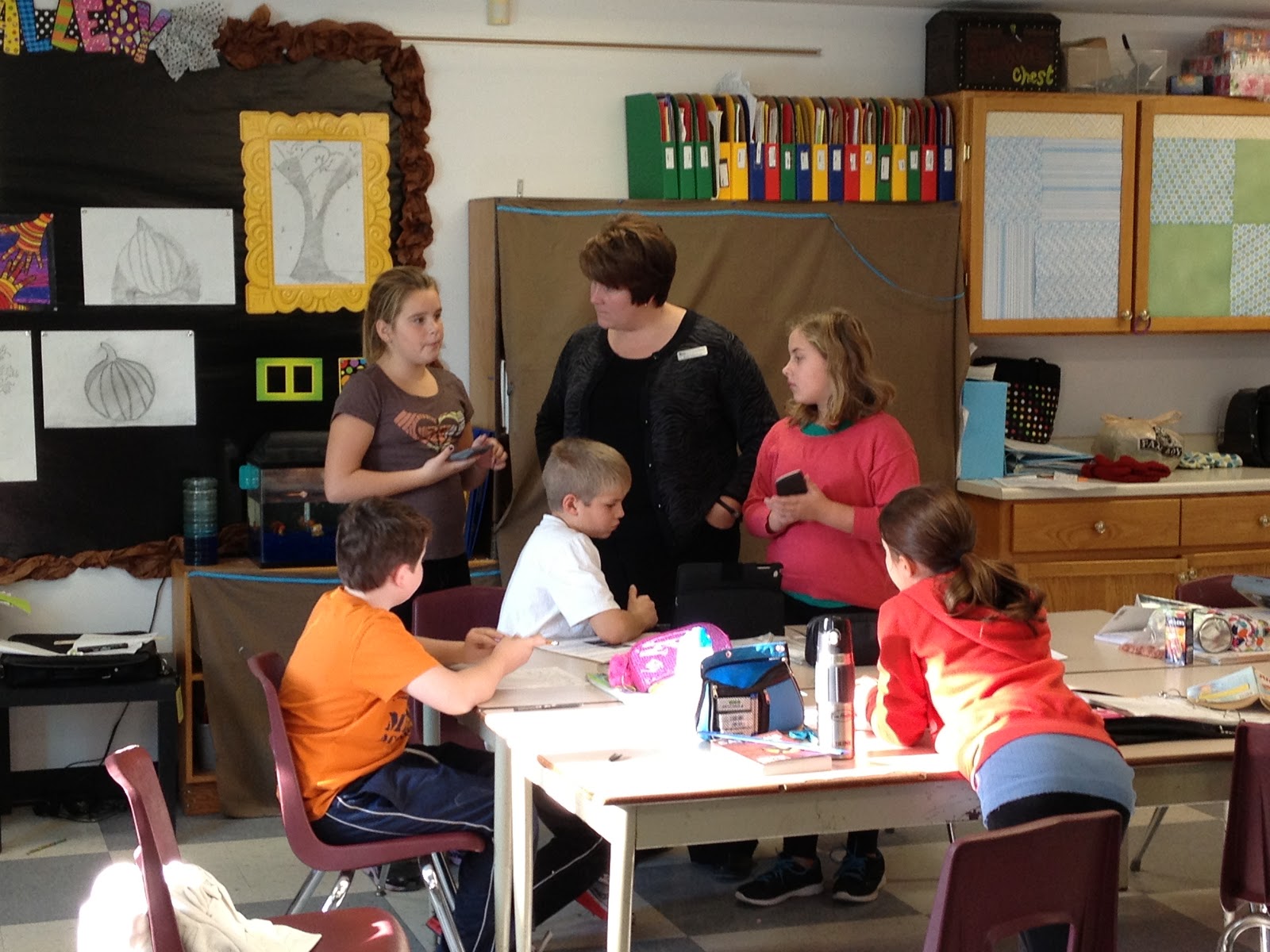 |
| Kim Machan engages some interesting thinking from the kids in this group. They were talking about solar panels and used a calculator to show her how sand on the panels could be an issue. |
 |
| This group read about harnessing the wind to air condition, using an ancient approach that is better for the environment. They were so intrigued that they went online to find out more - because they want to build them at home! |
They did a fantastic job for a first Jigsaw activity. Kim commented that it seemed to be "business as usual" - now that's a great compliment, because it shows that they weren't putting on a show for someone new in the room. In fact, I don't think they really noticed, other than the fact that there was someone else to bounce ideas around with.
So this post isn't super mathy ... but that's the point, isn't it? My students were THINKING today - it tied into math, but it also tied in everywhere else. To borrow an overused term, we got out of the silo and I think we really got to play in the barnyard today. It was planned, but still flexible. It was neat, but dirty! We inquired together as students, as teachers, and as one learning community. Isn't that what it's all about? It was more than integration - it was learning. Plain and simple.
Tuesday, November 6, 2012
My Great Moment
Today I had a great moment.
We've been working away on Data Management and the focus has really been on selecting the most appropriate graph to display data. We've spent a great deal of our focused "instructional" time looking at the differences between bar graphs and line graphs - that you can't really effectively graph what the class's favourite type of pizza is on a line graph, but you can graph how many slices of pizza are eaten over the course of a month by the class. It's all about time comparisons versus quantity comparisons. For some reason, as educators, we often forget to go that extra step of looking into something other than a bar graph for favourites. It's my pet peeve. For goodness sake, there's more to data management than surveying whether people like rain or don't like rain!
The other day, I gave the kids a graph with only the data on it. No labels, no numbers, no title. Their job was to list out possibilities for what the data was representing, and then to select the best option and complete the graph so that it suited their idea. I thought this wasn't asking too much. But, apparently it was. Although we'd worked forward - building the graph - working backward was apparently very difficult. It really begs the question - are we over marking our students in data management by expecting the bare minimum? It would explain why at multiple schools, the data management strands are often low on the EQAO results. This experience prompted me to explicitly teach that line graphs were about timelines, since the graph I showed them was a line graph, and yet many students were suggesting that the graph might be about people's favourite fill-in-the-blank. UGH!
So, today we kicked things off with a review/consolidation on graphs of all sorts. I made it EXPLICITLY CLEAR, and re-asked the same question I'd asked last week:
Ask a question about your environment (it could be fact based or opinion based). Get creative! Find the data, and select the most appropriate graph to display your results. Be sure to make thick and thin observations.
(Thin = right there; for example, on Monday, the temperature is 2 degrees celsius.
Thick = think about it/do some work; for example, the temperature will drop by 5 degrees between Monday and Thursday.)
The kids are really getting into it: they're surveying the school to see who is wasting electricity by leaving lights on when they don't need them, who is throwing paper into the garbage can instead of the recycling bin, or who is leaving projectors on when they aren't using their Smart Boards.
But what really excited me - what really was a "great moment in teaching" - was when two boys who are quite intuitive with their math work and often speed through - approached me with the idea that they'd like to compare the use of lights over the course of the week - so they wouldn't be able to finish today, but would need the rest of the week.
BINGO! This is what it's all about. They're buying into it, and making their learning meaningful on their own. They don't need me to do it for them anymore. The fireworks went off! I did my happy dance! Two down, 19 to go!
We've been working away on Data Management and the focus has really been on selecting the most appropriate graph to display data. We've spent a great deal of our focused "instructional" time looking at the differences between bar graphs and line graphs - that you can't really effectively graph what the class's favourite type of pizza is on a line graph, but you can graph how many slices of pizza are eaten over the course of a month by the class. It's all about time comparisons versus quantity comparisons. For some reason, as educators, we often forget to go that extra step of looking into something other than a bar graph for favourites. It's my pet peeve. For goodness sake, there's more to data management than surveying whether people like rain or don't like rain!
The other day, I gave the kids a graph with only the data on it. No labels, no numbers, no title. Their job was to list out possibilities for what the data was representing, and then to select the best option and complete the graph so that it suited their idea. I thought this wasn't asking too much. But, apparently it was. Although we'd worked forward - building the graph - working backward was apparently very difficult. It really begs the question - are we over marking our students in data management by expecting the bare minimum? It would explain why at multiple schools, the data management strands are often low on the EQAO results. This experience prompted me to explicitly teach that line graphs were about timelines, since the graph I showed them was a line graph, and yet many students were suggesting that the graph might be about people's favourite fill-in-the-blank. UGH!
So, today we kicked things off with a review/consolidation on graphs of all sorts. I made it EXPLICITLY CLEAR, and re-asked the same question I'd asked last week:
Ask a question about your environment (it could be fact based or opinion based). Get creative! Find the data, and select the most appropriate graph to display your results. Be sure to make thick and thin observations.
(Thin = right there; for example, on Monday, the temperature is 2 degrees celsius.
Thick = think about it/do some work; for example, the temperature will drop by 5 degrees between Monday and Thursday.)
The kids are really getting into it: they're surveying the school to see who is wasting electricity by leaving lights on when they don't need them, who is throwing paper into the garbage can instead of the recycling bin, or who is leaving projectors on when they aren't using their Smart Boards.
But what really excited me - what really was a "great moment in teaching" - was when two boys who are quite intuitive with their math work and often speed through - approached me with the idea that they'd like to compare the use of lights over the course of the week - so they wouldn't be able to finish today, but would need the rest of the week.
BINGO! This is what it's all about. They're buying into it, and making their learning meaningful on their own. They don't need me to do it for them anymore. The fireworks went off! I did my happy dance! Two down, 19 to go!
Subscribe to:
Posts (Atom)